Little Frames, Loud Voice: Why A5 Scottish Prints Punch Well Above Their Weight
Photo: Majel G. Claflin, CC0, via Wikimedia Commons
There is a particular kind of Scottish hallway — the one between the front door and the living room, barely wide enough for two people to pass, usually with a radiator on one side and a coat hook on the other. Hang a big landscape there and it does not make the space feel grand. It makes it feel like you have made a mistake.
This is why small prints have been quietly gathering momentum. Not as a compromise, but as the correct answer to a very specific set of British housing problems: narrow walls, box rooms, rented flats where you cannot drill, home offices carved out of a corner, and a budget that has already been spent on the deposit.
First, the honest numbers
A5 is 148 × 210mm — half a sheet of A4, roughly a paperback. A4 is 210 × 297mm. On a four-metre sitting-room wall, A5 alone is going to look lost. But put that same A5 print behind a generous mount in a 20 × 25cm frame and it reads as a proper picture, not a postcard. The print has not changed; the frame has changed the conversation.
A4 with a 6cm mount in a 30 × 40cm frame is the classic sweet spot — big enough to hold a wall, small enough to hang almost anywhere, and still comfortably under £40 framed if you shop sensibly.
Where small genuinely wins
Narrow hallways between doorways. The sliver of wall beside a chimney breast. The space above a desk, where anything larger would loom over you while you work. Bedside walls, at the height your eye lands when you are sitting up with a cup of tea. Kitchen dressers, shelf backdrops, the downstairs loo — the most forgiving room in any house, and the one where a single small print tends to get the most compliments.
Small also wins on logistics. An A5 print in a board-backed envelope posts as a large letter, which makes it the easiest possible gift to send to someone in Aberdeen or Southampton. And if you are moving a print across the country in a rucksack, A5 slips into a laptop sleeve without a second thought.
Mountboard is the entire game
This is the bit most people skip, and it is the difference between a print that looks considered and one that looks like it fell out of a magazine.
On an A5 print, aim for a mount of 5–8cm on each side, in off-white or warm white rather than bright white. Keep the frame moulding slim — 2–3cm is plenty at this size, because a chunky frame around a small picture makes the picture look smaller, not bigger. If you are hanging several pieces together, keep the frames and mounts identical so the group reads as one thing rather than six.
A bare A5 in a clip frame looks like a postcard. The same print in a 6cm mount looks like you knew what you were doing.
Grouping without it turning into a jumble sale
Small prints work best in numbers, but only if you impose some discipline on them. A grid of four or six, all the same size and frame, reads calm and deliberate. A row of three along a hallway is almost impossible to get wrong.
Leave 5–8cm between frames, and choose one alignment to hold: either line up the centres or line up the outer edges, never both. Keep the palette consistent even when the subjects vary — three different Scottish landscapes in the same muted greens will hold together; three wildly different colour schemes will not. Cut paper templates and tape them to the wall first. It takes ten minutes and saves a lot of filler.
Odd numbers generally feel more natural than even ones, though a neat 2 × 2 block over a desk is the exception that proves the rule.
Subjects that still shout at half the size
Detail does not survive shrinking. A busy harbour scene with forty tiny boats will turn to mush at A5. What survives is silhouette, shape and a limited palette.
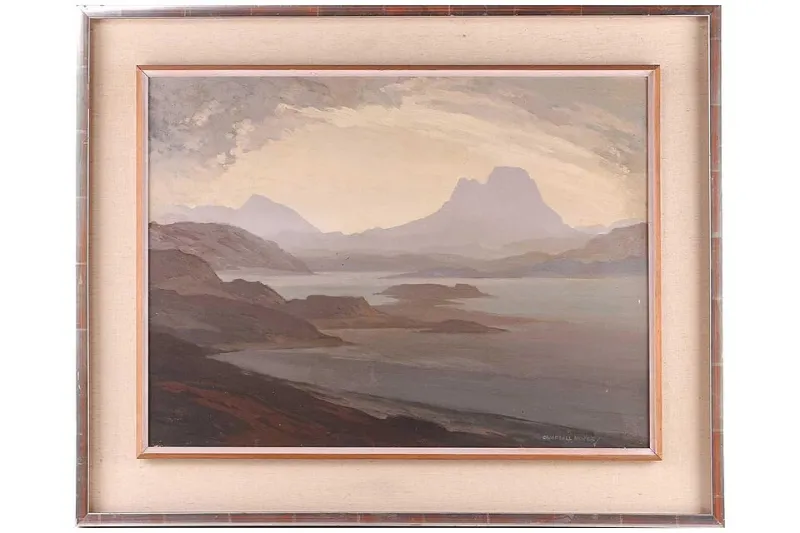
So lean towards the bold end of Scottish imagery: the Forth Bridge in profile, a lone bothy against a hillside, a lighthouse on a headland, Suilven or Buachaille Etive Mòr reduced to pure shape, a tenement close door in Glasgow, a single thistle, a contour-line map of a favourite glen. Anything with a strong outline and three or four colours will still read clearly from across a room.
City prints work particularly well small, because a skyline is essentially a silhouette anyway.
The gift angle
A5 has quietly become the ideal plus-one present. It sits comfortably under the £15–£20 mark that makes a gift feel thoughtful rather than extravagant, and it suits all those occasions where a bottle of wine feels lazy: the housewarming, the thank-you, the Secret Santa with a sensible limit, the friend who is moving away from Scotland and would quite like a reminder of it.
If you are posting, buy unframed and let the recipient choose their own frame — it travels better and it means the gift suits their wall rather than yours. If you are handing it over in person, a ready-made 20 × 25cm frame is a couple of pounds and turns a print into something that can go straight up that evening.
Framing without blowing the budget
Ready-made 20 × 25cm and 8 × 10 inch frames are widely available and cheap. Mount packs can be bought separately, or cut yourself with a cheap mount cutter and a bit of patience. Adhesive strips hold an A5 frame easily, so renters can hang a group of three without leaving a mark. And if you are starting out, buy three A5 prints in the same frame, hang them in a row, and leave it at that.
Small does not mean apologetic. It means you have looked at the wall properly and bought something that fits it.