The Commute, the Corner Shop and the Closes: Scottish Prints That Belong to Locals
There is a particular kind of Scottish print that follows you home from a weekend away. It has a castle on it, maybe a loch, possibly a stag standing about looking noble. It is fine. It is also the wall-art equivalent of a fridge magnet: pleasant, familiar, and almost entirely forgettable once the holiday glow wears off.
This is not a dig at tourists. Everyone should buy a wee reminder of a good trip. But if you live in Scotland — or you simply want your home to feel like it belongs to you rather than to a visitor centre — the rules are different. The prints that last are the ones that catch you off guard because they show a place you know. Not a place you once posed beside.
Tourist-Bait vs the View From the Bus Stop
Tourist-bait art tends to announce itself. It goes for the greatest hits: the perfectly symmetrical castle, the misty glen with a lone stag, the tartan border. None of that is wrong, but it is generic. It says “Scotland” in capital letters. It rarely says your Scotland.
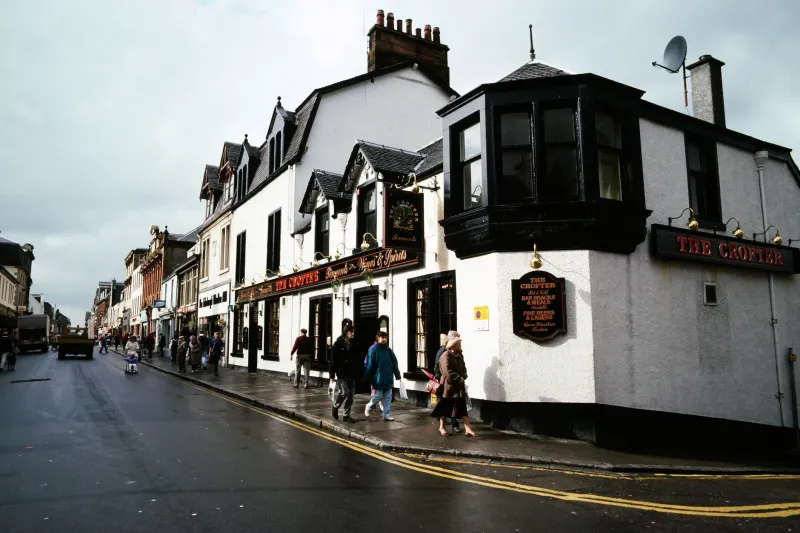
Local art is quieter. It might be the tenement close you walked past every day for years. The chippy on the corner at closing time. The view from the top deck of the bus as it comes over the hill. A park bench with the city skyline doing its normal, unglamorous thing behind it. These are the images that make someone pause and say, “I know that bit.”
That recognition is the whole point. A print does not need to be a landmark to be meaningful. Sometimes it just needs to be true.
What Locals Actually Recognise
A good test is to imagine the print without its title. Would you still know where it is? If the answer is “somewhere in Scotland, probably”, it might be decoration rather than connection. If you can name the street, the hill, the bridge or the colour of the bins, you are onto something.
The everyday stuff is underrated. A row of shops with flat windows above them. A cut-through path between schemes. The specific grey of a Scottish sky just before rain. The way a city centre empties out at tea time. These details are not dramatic, but they are intimate. They make a room feel lived in rather than styled by a tourist board.
This is also why local artists often make the best work for local walls. They are not trying to summarise the whole country in one image. They are noticing what is already there.
How to Spot a Print With a Pulse
Start by looking at what the artist has chosen to leave out. Tourist prints tend to cram everything in: the castle, the loch, the bagpipes, the weather. A stronger print usually edits. It picks one corner, one light, one ordinary moment and trusts it to carry the feeling.
Look for specificity too. Real places have awkward details — wheelie bins, bus stops, scaffolding, a stray traffic cone. A print that includes those things is usually made by someone who has actually stood there. That does not mean every print needs a bin in it. It means the artist is interested in the place as it is, not as a postcard.
And do not confuse “affordable” with “cheap-looking”. There are plenty of reasonably priced Scottish prints that feel considered: good paper, clean printing, a decent crop. You are paying for the eye, not just the ink.
Practical Picks That Don’t Shout “Gift Shop”
If you live north of the border, start with your own daily route. The street you walk to work, the park where you eat lunch, the view from the train. A small A5 or A4 print of a local scene can sit on a shelf or in a little frame without dominating a room. It is the visual equivalent of a familiar song.
For city dwellers, look for tenement details, closes, bridges, market streets and the weird little in-between spaces that make a place feel like itself. For anyone outside the cities, think hills, harbours, high streets and the specific bend in a road you would know anywhere. Heritage prints can work too, but choose the ones that feel like history rather than fancy dress. Tartan without the tin, so to speak.
If you are buying for someone else, resist the obvious. A print of their actual neighbourhood — or the park they take the dog to — will beat a generic castle every time. It says you have paid attention.
Framing for Real Rooms
Keep it simple. A thin black or natural wood frame suits most Scottish prints and stops them looking like souvenirs. Off-white mounts give the image some breathing room. If you are renting, a shelf, a picture ledge or a leaning frame does the job without nails. Group two or three smaller prints rather than one big statement piece; it feels more collected and less like a display.
And do not hang everything at eye level in a neat row. Real homes are a bit wonky. A print above a desk, one by the kitchen door, one in the hall where you dump your keys — that is how local art beds in.
A Note for Anyone South of the Border
You do not need a Scottish postcode to buy this way. Plenty of people in England, Wales and Northern Ireland have a Scottish connection, a favourite city, or simply a love of how Scotland looks in ordinary light. The same rule applies: choose the print that means something to you, not the one that looks most like a calendar.
A home should not feel like a gift shop. It should feel like someone lives there. Scottish prints can do that beautifully — as long as they are showing you a place, not just selling you a country.
In 2026, with more affordable print options than ever, there is no need to settle for the shortbread-tin version. Pick the bus stop. Pick the park. Pick the close you always cut through. Your walls will thank you.